by Kim van Veen

Islamist rebels entered the Lubero district early in the morning and rounded up 70 Christians in February of this year. They forced the group into a small church in Kasanga, tied them up, and beheaded them.
This is just one of many massacres that have taken place in the Democratic Republic of the Congo (DRC) in the last 35 years, and most of the global church has no idea that it is happening.
Since December 2024, at least 237 Christians have died at the hands of Islamists, according to Barnabus Aid. And the ministry estimates more than 6,000 Christians have been killed since 2017.
The northeastern region of the DRC has dealt with conflict for more than 35 years, displacing more than 7 million people throughout the country. Tensions flared again this year when clashes broke out between one of the rebel groups and Ugandan government forces.
Pastor James Byensi, missions director for the Evangelical Church of Central Africa (CECA 20), said the conflict has deeply affected his denomination, which is the largest in the region.
“We have lost so many people in the eastern Congo and so many churches. Our denomination alone has lost over 400 local churches,” Byensi said. The community where 70 Christians were beheaded was a CECA 20 church.
“The feeling is that we are kind of alone,” Byensi said. “The story of the suffering people in the Congo is not told enough.”
CECA 20 is based in the city of Bunia, where MAF has had a base since 2021 after evacuating the previous base 25 miles away in Nyankunde due to regular rebel activity.
After most expatriate missionaries left the DRC in 1996 during the First Congo War, CECA 20 continued developing indigenous pastors and missionaries, as well as planting churches all over the eastern part of the country. Today, they have more than 1,500 local congregations.
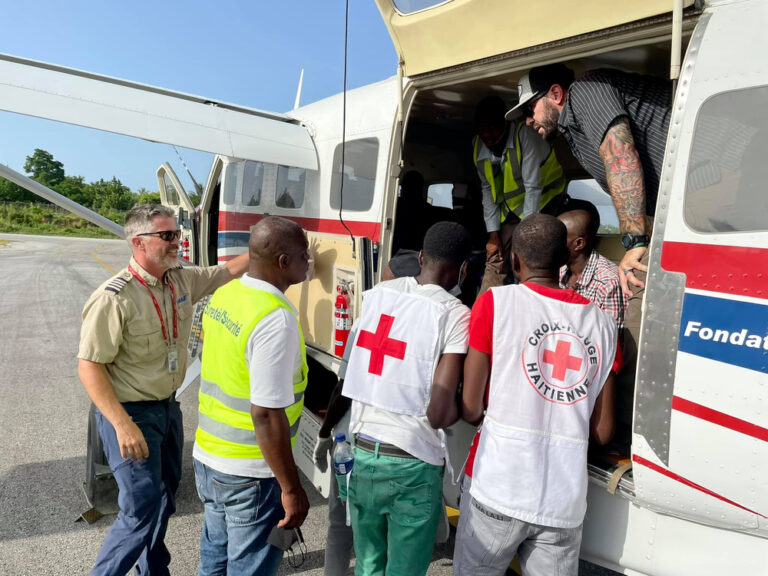
CECA 20 is one of MAF’s closest partners. Almost every week, MAF carries CECA 20 pastors, medical workers, teachers, or missionaries deep into the DRC’s interior.
“The CECA 20 church is one of the most tangible ways that MAF is bringing help, hope, and healing in eastern DRC. Whether it is bringing national missionaries to reach new tribes in the north or supporting their work in encouraging established churches suffering from violence, each flight for CECA20 has a clear eternal impact,” MAF pilot Dave Petersen said.
Byensi has served with the denomination since 2000, first as a pastor and now overseeing mission outreach. CECA 20 regularly ministers to the millions of displaced people, often using MAF to cross dangerous, rebel-controlled territory where they would risk kidnapping, extortion, and death.
In April, MAF carried Byensi and a team of 24 evangelists and worship leaders to encourage the large number of displaced people in Beni. The region is known as the “triangle of death” and is where the Islamist Allied Democratic Forces (ADF) rebel group operates.
MAF regularly flies to Beni, and “it is often easy to forget that in just 30 minutes in the air we fly over more than six armed groups that continue fuel the conflict in the area,” Petersen said.
The CECA 20 team met believers and held events to encourage displaced Christians. For many of them, it was a reminder that someone cared. For others, a meal served was the first time in eight months they had tasted chicken.
Byensi and the team taught from 1 Peter, which was written to dispersed Christians like those they served.
“The same scripture is now applying to us today: that we need to stand strong. We need to keep our faith alive, and we need to keep going no matter what we are going through,” Byensi said.
Long years of war and fleeing marauding soldiers have affected the believers.
“People are discouraged. Yes. But they are not throwing in the towel,” Byensi said.
Instead, they have adapted. Whenever they have to move, they plant a church in the new location. Byensi compared it to the early church in Jerusalem, when persecution caused believers to leave the city and start churches all over the world.
“As people keep running away … they’re running with their faith and planting churches,” he said.
As the missions director, Byensi seeks to encourage these church planters on the run and equip them with whatever they need for their local congregations. However, his role as a church leader in this area puts him at risk.
“My life is always under threat,” he said.
He has some peace of mind thanks to a standing evacuation order with MAF, meaning that if he needs to leave in a hurry, MAF will fly him out of Bunia. “We thank God for MAF,” he said.
Working in an area with these deep difficulties has taken a toll on Byensi. It’s not easy on his family, either.
In February, Byensi, his wife, three children, and all the MAF staff in Bunia had to evacuate suddenly when a militia threatened to overrun Bunia. Thankfully, everyone was able to return seven weeks later after things settled down.
“Even during the hardest time, [MAF] evacuated their families in Uganda,” he said. “[But pilots] were flying all day. So this is the only airline that we can count on.”
Byensi says that those supporting MAF’s work in the DRC are saving lives by enabling the organization’s presence there. Petersen, who has spent 10 years as a pilot in DRC, said one of the ways he copes with the extreme suffering he knows is all around him is by boxing in the emotion and focusing on the practical parts of the job.
“The Lord alone knows how many lives have been saved by MAF providing a safe bridge over these conflict zones,” Petersen said. “One day in heaven I look forward to seeing the whole story and what would have been if MAF was not there.”
“When you are exposed to this much suffering, it hits you hard,” Byensi said. “But now what do you have to do? You have to continue.
“We thank God for the Scripture because the Lord Jesus was so clear on this, when he gives us the message in John 16:33, that in this world you will face many tribulations. But you need to be courageous, because I have overcome the world.
“Those are kinds of scriptures that keep us standing.”